- The GTM Generalist
- Posts
- Clear Eyes. Full Inbox. Can't Lead?
Clear Eyes. Full Inbox. Can't Lead?
What Grammarly's acquisition of Superhuman tells us about the future of productivity apps

Drew Bear
July 17, 2025
I got an email from the CEO of Superhuman that caught me off guard: "We're being acquired by Grammarly."
Wait. You mean the spell checker extension I used back in college?!
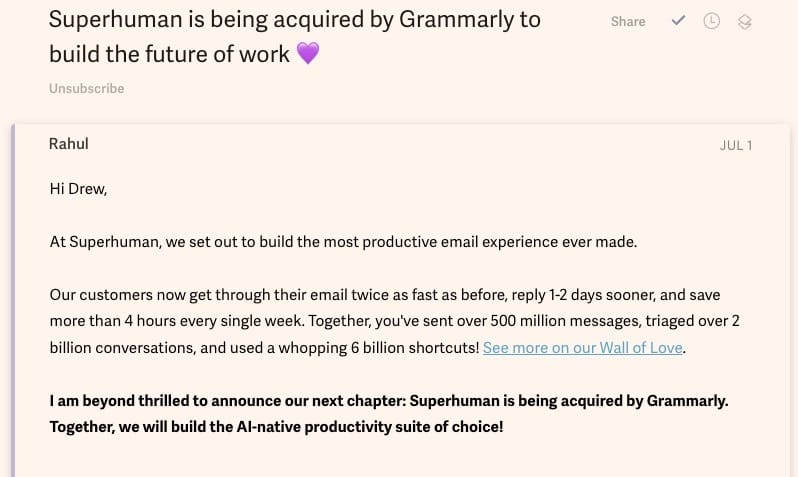
I did a quick search and saw that Grammarly had also acquired Coda, the productivity app, last December.
Suddenly, my favorite email tool's acquisition felt less random and more revealing.
Because what Grammarly's doing isn't just bundling email, spell check, and documents.
It's trying to become something new: an AI-native productivity suite for knowledge workers. And they're not alone in seeing this future.
Granola. Grain. Fyxer. Superhuman. Grammarly. These aren't just productivity tools.
They're competing visions for how we'll work in the AI era. Each betting they know what leaders really need to be productive.
And if you zoom out, you'll see they're all fighting for control of the same thing: the context that makes up your work.
Your inbox. Your meetings. Your calendar. These platforms already know how you spend your time.
But here's the real question:
If these productivity apps already know what you're doing all week, why don't they help you feel more in control of your work?
This essay explores what’s missing in today's productivity apps, and how the most strategic ones will evolve to help founders and marketers make better decisions, not just work faster.
The False Promise of Faster Tools
Productivity tools love to sell speed.
Faster emails. Faster meeting notes. And faster document reviews.
More automation. Less manual work.
But here's the uncomfortable truth: Our tools have made us faster at being lost.
Marketing leaders have invested heavily in productivity software; 67% increased their SaaS spend just to prove revenue impact.
Yet they still lose thirteen hours every week to manual tasks, while 43% of their data sits duplicated across nineteen different tools.
Sales teams face a similar paradox.
Despite having more productivity tools than ever, only 42.7% of B2B Account Executives hit their quota in Q2 2024.
We're getting faster at activities that aren't moving the needle.
This isn't just about inefficiency.
It reveals something deeper: Our obsession with saving time has come at the cost of strategic clarity.
We've optimized for speed but lost sight of what makes work meaningful and impactful.
The question isn't why we can't work faster—it's why working faster isn't working.
The Emotional Weight Our Tools Miss
This isn't just a GTM problem. It's a cognition problem.
Cal Newport calls it the "cognitive death spiral."
Our brains get rewired to chase faster stimuli, not solve harder problems. Context-switching becomes our dominant state.
And the more fragmented our work becomes—Slack, email, Loom, Notion, AI agents—the less space we have to think clearly.
The evidence is stark: MIT's research shows that 72% of executives and middle managers can't name three of their company's top five strategic priorities.
One-third of leaders tasked with implementing strategy can't list even one.
And so the strategic work suffers.
We don't know what to prioritize. We don't realize how little time we spend on high-leverage work.
We feel overwhelmed even when we've "saved time." The tools aren't helping us think.
Sam Corcos, the co-founder and CEO of Levels discovered something startling about this cognitive burden.
After meticulously tracking two years of his work, he found that strategic tasks, which felt like they consumed massive amounts of time, actually took up just 5% of his schedule.
For him, he found that writing a strategy memo usually required only 30-60 minutes to complete, but it feels like it takes much longer.
His reflection captures a deeper truth about productivity:
"Be mindful that the way you're actually spending your time might be different than your expectation. You may need to reprioritize. In our case, I've often worried that we spend too much time thinking about strategy and writing documentation. As anyone who has seen our strategy documents will tell you, they're extremely comprehensive. But upon realizing that it's only 5% of my time, it made me realize that we may actually be under-investing in strategy."
The emotional weight of strategic work distorts our perception of time.
We delay important tasks because they feel overwhelming, when data shows they take far less time than we imagine.
Our tools might save us time, but they don't help us overcome these cognitive barriers to meaningful work.
Where Context Lives: The Race to Shape How We Work
These cognitive challenges demand a new approach to productivity.
While speed amplifies our struggles with clarity and focus, having the right context might help us make better decisions amid the noise.
And that's what makes the current landscape of productivity apps so interesting.
Each company is racing to become the foundation of work by controlling where context lives.
Why? Because that context—meetings, emails, transcripts, docs—is the raw material an AI agent needs to do useful work.
In customer conversations, Gong and Grain are competing to turn sales and success calls into strategic insight.
In the broader meetings space, Granola is betting that the insights in back-to-back meetings, both internal and external, hold the key to better leadership.
Notion captures the context of how teams document and share knowledge.
And in email, the competition is especially fierce.
Superhuman bet on interface perfection—building an experience so fluid that busy executives pay $30/month to feel in control of their inbox.
Fyxer took a different approach, turning six years of executive assistant expertise into AI-powered inbox automation.
Meanwhile, Slack won't let anyone else touch your messages—a defensive move that signals just how valuable conversation context has become.
The race for context isn't just about winning, it's about surviving.
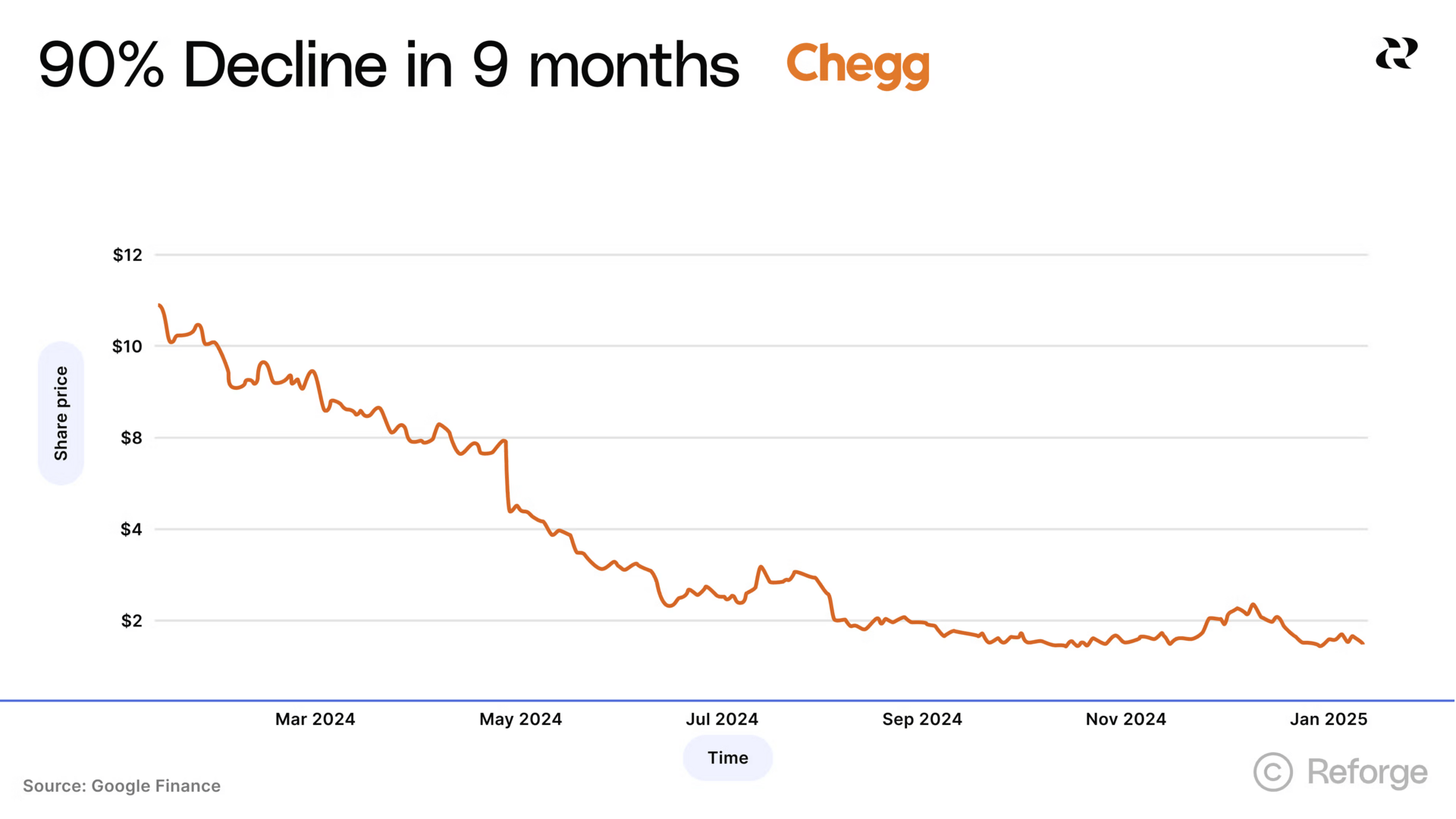
Just look at Chegg who experienced a collapse in product market fit.
In less than nine months, their valuation of $1.2B dropped 90% when AI threatened their core business of homework help.
They lost half a million subscribers because they bet on owning content that AI could easily replicate.
The productivity companies that will thrive will need to own the right kind of context.
The kind that helps leaders make sense of their constantly shifting work.
If you're a founder or GTM Marketer, you're moving between strategy sessions, sales calls, content reviews, and operations every hour.
You don't need another place to capture information. You need tools that help you see the patterns that matter.
Principles for Building Tools That Help Leaders Think
The next wave of AI-powered productivity tools must evolve beyond capturing information to helping leaders think and reflect better.
Chris Pedregal, Granola’s CEO outlines four principles for building these tools:
1. Don't solve problems that won’t be problems tomorrow
The pace of LLM innovation means today's differentiators become tomorrow's commodities.
Features like grammar checking, once Grammarly's moat, will soon be ubiquitous (which pretty much already is).
Even Superhuman's UX perfection may not be enough one day.
The key is identifying which user problems will persist even as AI capabilities advance.
What challenges will leaders face when basic tasks are automated? What cognitive burdens will remain when processing power is unlimited?
2. Your scale is my advantage
Large incumbents face a surprising constraint: scale itself.
Grammarly's billion-dollar raise isn't just for acquisitions. It's because serving millions of users with cutting-edge AI is exponentially expensive.
This creates room for startups to build premium, insight-driven experiences for smaller audiences.
3. Context is king
As I mentioned earlier, it will be essential for productivity software to empower users to have cognitive clarity across the various contexts they work in.
Imagine tools that don't just transcribe meetings, but help you map conversations to strategic objectives.
Tools that don't just track time, but help visualize emotional friction points in your week so you can work on your highest leverage projects.
4. Go really narrow and deep
Success comes from solving specific cognitive challenges exceptionally well.
Rather than trying to capture everything, focus on helping leaders see what matters in key moments.
This means obsessing over every element that helps leaders maintain clarity and strategic focus.
It's about reducing cognitive load through smart defaults. Surfacing insights without requiring constant attention. And creating experiences that maintain flow rather than breaking it.
Leadership isn't just about execution. It's about discernment.
Our tools need to evolve to support this higher-order thinking.
A Different Way to Think About Productivity
The goal of productivity software isn't to help you do more work. It's to help you do the right work and lead others to do the same.
True productivity isn't measured in tasks completed or time saved.
It emerges when teams can understand their work deeply enough to make confident decisions.
When they can cut through noise to find signal and have the emotional clarity to move with purpose.
For those building productivity tools for GTM teams, the message is clear: Don't just build to speed up output.
Help your users see their work clearly, so they can lead better.
Time saved is a metric. Clarity is a moat.
Whoever helps us see clearly—wins.